
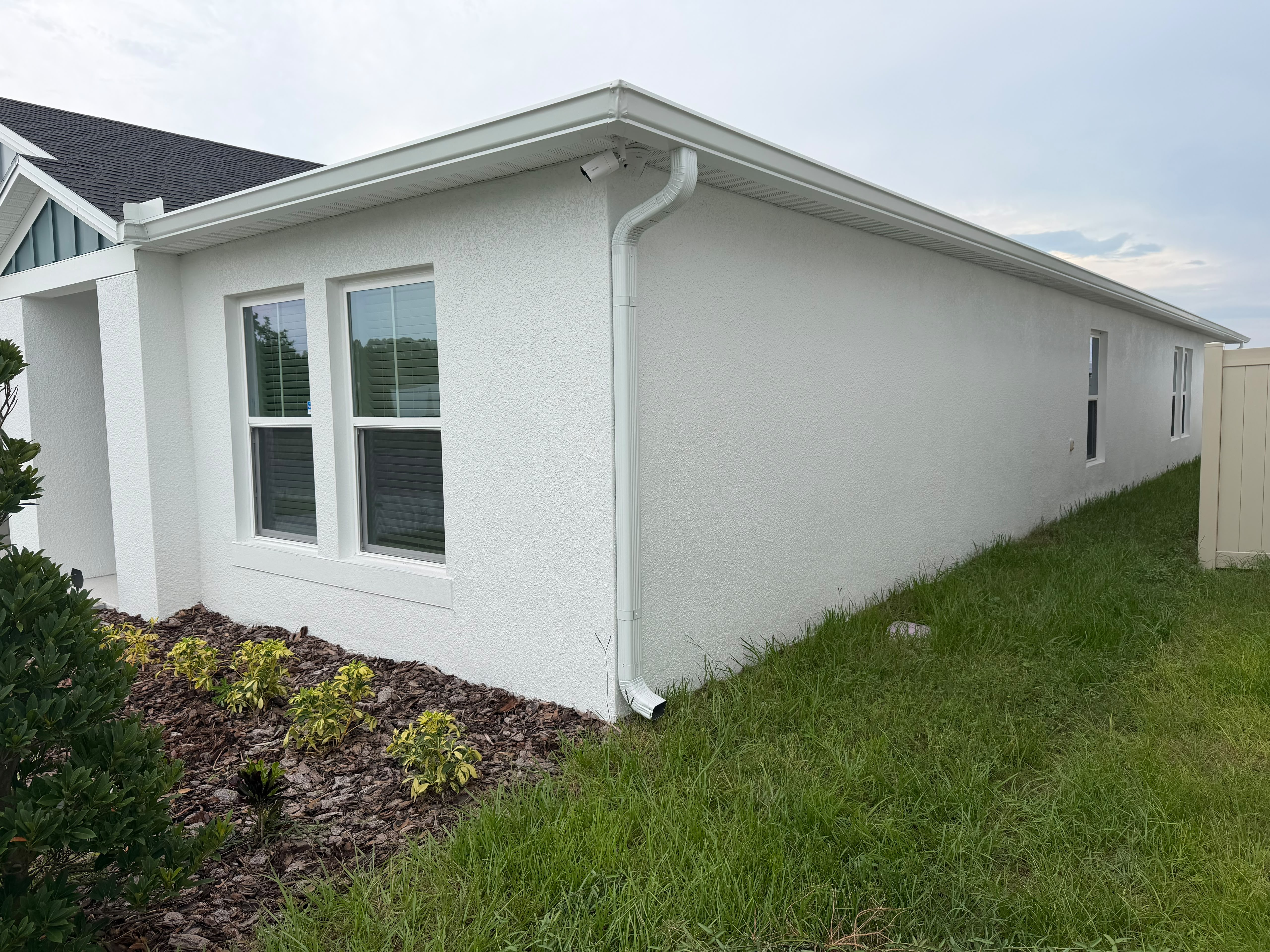
Short answer. Seamless aluminum gutters are continuous runs formed for one roofline, so long straight sections have fewer joints than sectional lengths. They fit many Orlando and Sarasota homes when the fascia, outlets, and downspouts are planned together. They are not the right edge treatment for every roof, and a larger profile is not an automatic upgrade.
Seamless means fewer joints along a straight run, not a finished drainage system.
A seamless aluminum gutter is formed to the length of a roof edge, usually on site, instead of being assembled from short factory sections. That reduces the number of joints along a straight run. Corners, end caps, outlets, and the change from one roof plane to another are still separate pieces. The U.S. Department of Energy’s Building America guide treats the gutter, the downspout, the grade, and the place water is released as one roof-runoff plan. A continuous trough by itself is not that plan.
- Straight runs can be formed in one piece for that roofline.
- Miters, outlets, and end caps are still joints that belong in the written scope.
- The downspout and the release point are part of the same decision as the gutter.
Aluminum is the usual residential coil. The written scope names the material that will actually be installed.
Painted aluminum coil is the material PrimeFlow uses for most residential seamless gutters in Orlando and Sarasota. ASTM B209 is the public specification family for aluminum and aluminum-alloy sheet and plate. This page does not name a thickness, a temper, or a brand of coil. Those details belong on the written scope after the roofline is measured. A homeowner comparing proposals should look for the profile, the color, the outlet count, and the downspout route, not only the word “aluminum.”
When another metal is the real question
Copper and bronze are different materials with different appearance, cost, and installation demands. They are not a default upgrade from aluminum. The copper and bronze guide explains when that conversation is worth having, and when seamless aluminum remains the practical scope.
Florida rain is a reason to plan the route, not a reason to pick one profile for every house.
National Weather Service Melbourne describes a warm-season pattern in east-central Florida: afternoon storms tied to the sea breeze, with a wetter stretch that commonly runs through the summer months. Southwest Florida sees its own storm pattern under the Tampa Bay forecast office. Neither page is a design rainfall for a single roof. SMACNA’s gutter and downspout calculator asks for rainfall intensity, roof area, gutter length, and the number of downspouts together. PrimeFlow uses that kind of combined review at the property. This article does not publish a rainfall rate or a calculator result.
A site visit decides whether seamless aluminum fits that edge.
The assessment looks at the roof planes that feed each run, valleys, pitch, fascia condition, story height, access, existing gutters, and where water can leave the downspout without landing on a walkway, a lanai, or the base of the wall. Tile roofs, long runs, and tight side yards change the work even when the material stays aluminum. Six-inch and seven-inch profiles are both aluminum options. Six-inch is a common residential starting point. Seven-inch is reviewed when the roof demand supports it. Neither size is assigned from the street.
- Which roof planes and valleys feed this edge.
- Whether the fascia can take the hanger the system needs.
- How many outlets and downspouts the run should have.
- Where the downspout can release water on this lot.
- What has to be removed, protected, or left out of the scope.
Seamless aluminum does not manage city drainage, groundwater, or storm surge.
A gutter collects roof water from the edges it serves and sends it to a downspout. It does not replace a city storm drain, a swale, a floodplain rule, or protection from surge. This guide does not quote a code section, decide a permit, or claim that a gutter project complies with the Florida Building Code. Read the current code with the building official for the property address. Florida’s plumbing storm-drainage chapter is the public starting point for those design questions, and the building official for the address decides how it applies.
A free estimate is not a booked installation.
PrimeFlow’s estimate is free and does not obligate the homeowner. Installation is scheduled after a written scope and the required deposit, unless a written waiver says otherwise. This page does not quote a price. Two aluminum proposals can differ because the profile, outlet count, downspout size, removal, access, and color are not the same scope.