
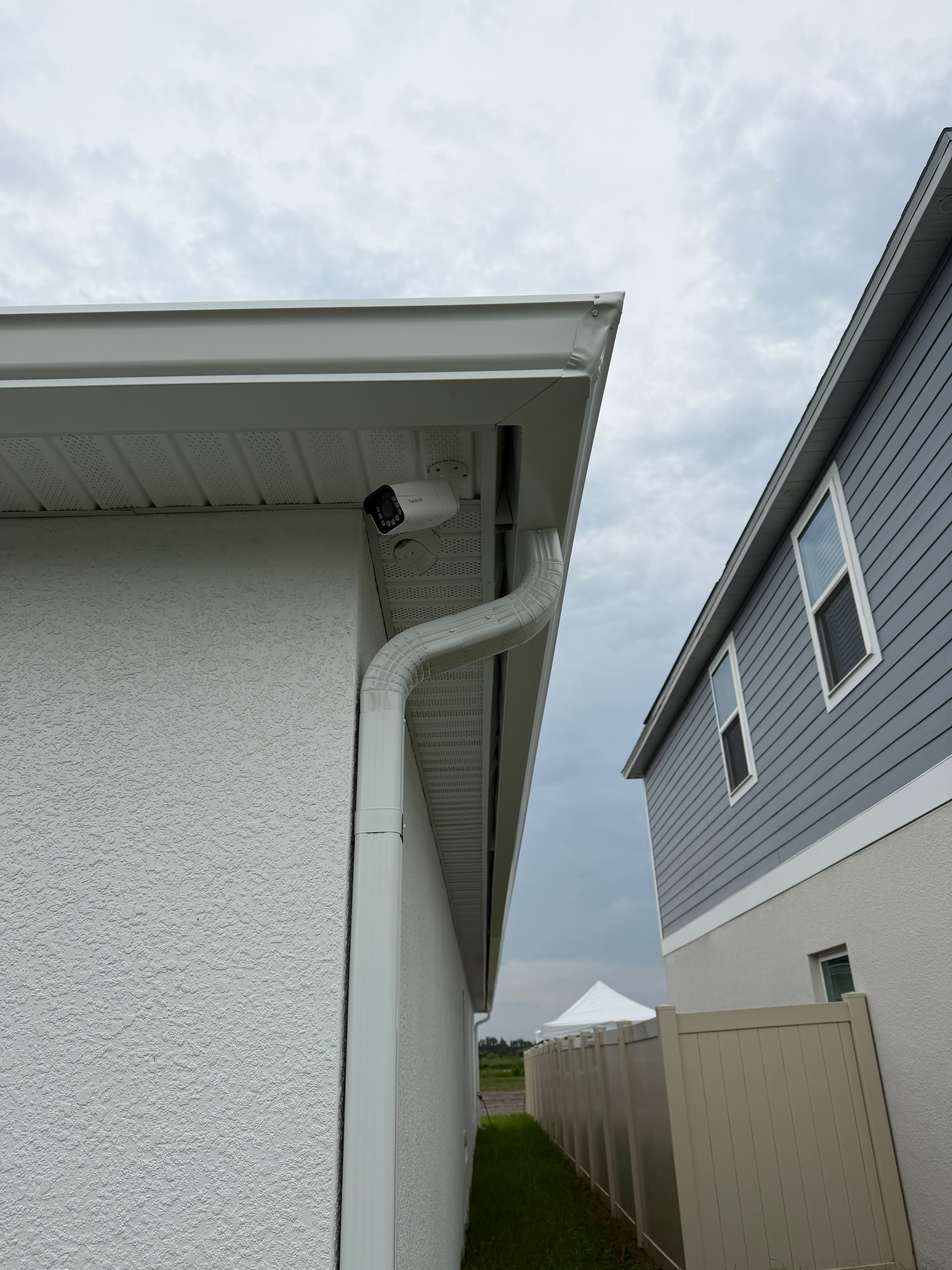
Start by identifying where the water first appears.
The Southwest Florida Water Management District explains that rainfall moving over roofs, driveways, roads, and other impervious surfaces becomes stormwater runoff. Water spilling from a specific gutter run, valley, end, or outlet is a different observation from water rising across a yard or moving in from a street. During a safe rain event, note whether the concern begins at the roof edge, downspout discharge, a low area in the lot, or beyond the property.
Localized overflow can have several gutter-system causes.
Visible debris, a restricted outlet, inadequate pitch, a loose section, concentrated valley flow, insufficient downspout capacity, or a gutter profile that does not match the roof may contribute to localized overflow. The pattern should be assessed before choosing a correction. A larger gutter or added downspout can be useful in the right conditions, but neither should be sold as an automatic answer without reviewing the complete route.
Broad ponding may extend beyond roof-water scope.
Water that covers a wide area, remains far from the roofline, rises from the ground, enters from an adjacent property, or corresponds with street flooding may involve grade, soil, groundwater, public drainage, or other site conditions. Directing roof runoff more deliberately may reduce one input, but it does not prove that the broader condition will be resolved. Those situations may require a drainage, landscape, civil, or flood specialist.
A useful assessment defines the boundary in writing.
PrimeFlow Gutters can document the roof edges being served, gutter profile, outlets, downspouts, intended discharge direction, visible conditions, and exclusions. The written scope should not promise flood control or a universal dry-yard result. It should state what portion of the roof-water route is being improved and identify conditions that remain outside the gutter installation.