
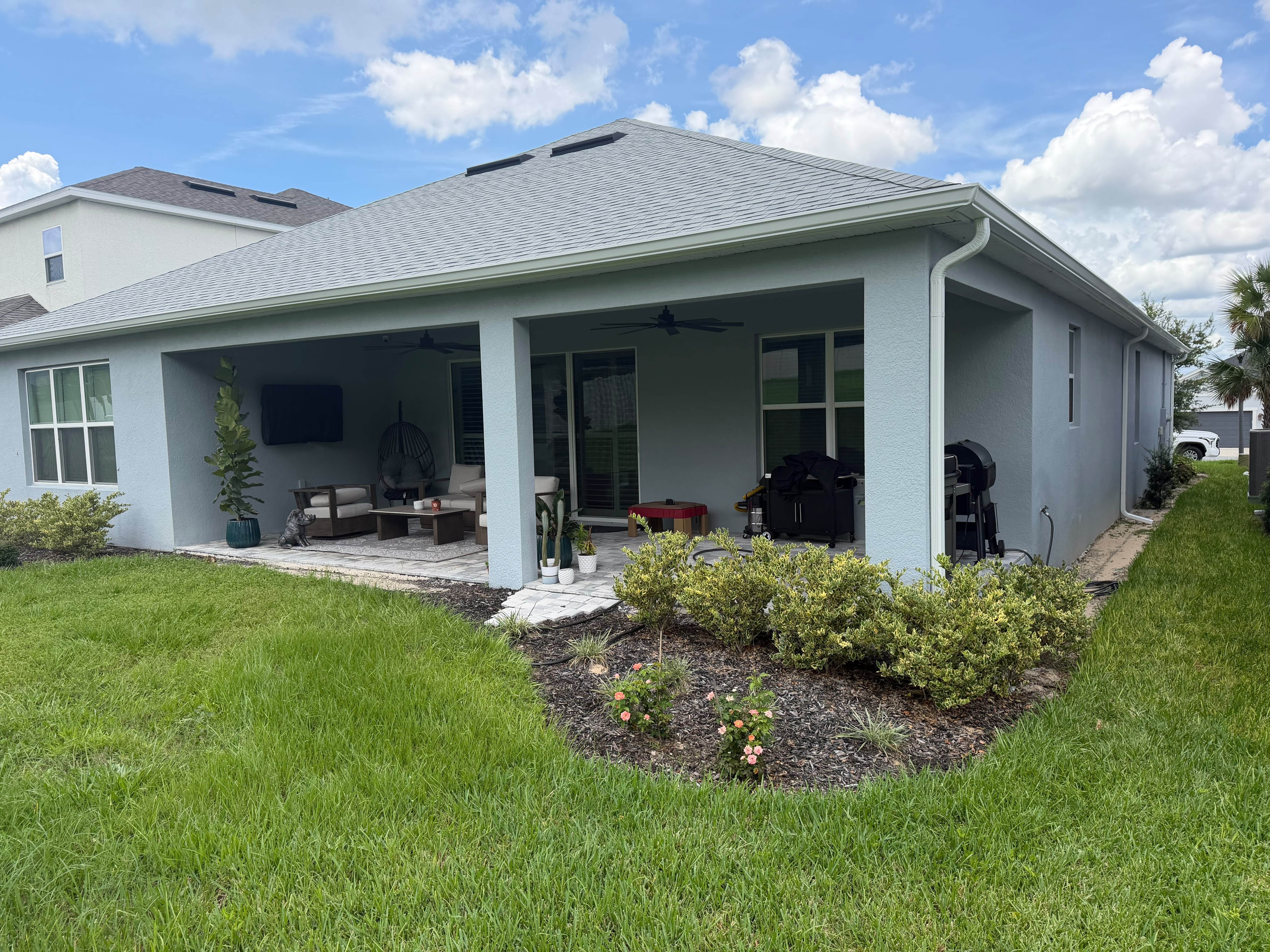
A valley gathers water from more than one roof plane.
Where sloped roof planes meet, the valley carries runoff toward a narrower exit area. During a strong Florida rain event, that location may receive substantially more water than a simple section of eave. The visible spill point can be dramatic, but the solution should not begin with a product assumption. The contributing roof area, pitch, valley geometry, roof material, edge details, and exact receiving location should be reviewed first.
Gutter profile is one capacity decision.
A 7-inch gutter may warrant evaluation where large planes, steep slopes, tile, or concentrated valley flow create higher demand. Six-inch gutters remain a premium residential standard for many Florida homes. The appropriate profile depends on the measured route and available roof-edge conditions. A larger profile should not be treated as a guarantee against every overflow event or as a substitute for outlet and downspout planning.
The outlet should be positioned for the actual flow pattern.
An outlet located far from a concentrated valley may require water to travel a long horizontal distance before exiting. In some systems, changing outlet placement, adding an outlet, or revising the downspout plan may be more useful than enlarging the gutter alone. The installer should also consider corners, long runs, elbows, brackets, vertical alignment, and a practical discharge area at ground level.
Tile and complex rooflines require safe on-site evaluation.
Roof material and geometry can change access, attachment planning, and how runoff arrives at the eave. Homeowners should not climb a roof to observe valley flow during a storm. From a safe ground-level location, record where water appears, how soon overflow begins, and whether the nearby outlet and downspout are moving water. PrimeFlow Gutters can use those observations during a property-specific assessment.